
Understanding how government works in Kenya is essential for citizens who want to participate meaningfully in public life and hold leaders accountable. At its core, government is defined by the Constitution, which outlines authority, responsibilities, and the relationship between leaders and citizens. By learning how the system works, we can better understand policies, how services are to be delivered, and the decision making processes that affect our everyday life.
This article explains how government works by examining institutions, various roles of leadership, and governance processes, while also exploring how the Kenyan government functions in practice.
To understand the system, one must begin with the Kenya government structure. The country operates under a constitutional democracy that establishes a clear system of government based on the separation of powers. This system of government in Kenya ensures that authority is divided to prevent abuse and promote accountability.
The broader governance system is guided by democratic principles, transparency, and the rule of law. Through this, citizens elect leaders and participate in shaping national priorities. These principles are implemented through the Kenya public administration, which manages public services and policy execution.
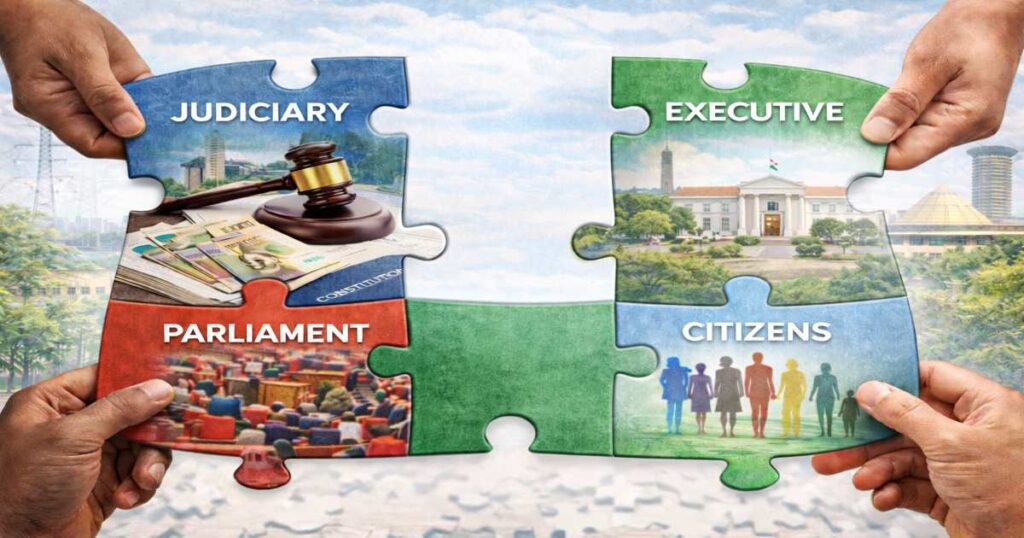
A key part of how government works lies in understanding the branches of government in Kenya. There are three main branches: the Executive, the Legislature, and the Judiciary. These branches of government operate independently but work together to govern the country.
The Executive implements laws, the Legislature makes laws, and the Judiciary interprets laws. Clearly defining the roles of government helps maintain balance and accountability within the state.
The Executive Arm
The Executive is the engine that drives how government works in Kenya. It is responsible for implementing laws and policies passed by Parliament and ensuring the day-to-day administration of the country runs smoothly. At the center of the Executive is the President, who serves as both the Head of State and Head of Government, giving the office immense influence over national direction.
The President exercises executive authority with the support of the Cabinet, which is made up of Cabinet Secretaries appointed from outside Parliament. These Cabinet Secretaries head key ministries such as Finance, Health, Education, Interior, and Transport, and are tasked with translating government policies into action. Through these ministries, the Executive manages public resources, oversees service delivery, and coordinates national development programs.
Understanding how the Kenyan government functions requires recognizing the President’s wide-ranging powers. These include setting policy priorities, directing national security through the armed forces and security agencies, and representing Kenya in foreign relations. The President also has the authority to appoint senior government officials, including ambassadors, principal secretaries, and heads of state corporations, subject to constitutional and parliamentary oversight.
The Executive plays a critical role in economic planning and management. It prepares the national budget, implements development agendas, and oversees major infrastructure projects that affect citizens’ daily lives. Decisions on taxation, employment programs, healthcare funding, and social protection initiatives largely originate from the Executive arm.
At the same time, the Constitution of Kenya places limits on executive power to prevent abuse. The Executive is accountable to Parliament, the Judiciary, and ultimately the people of Kenya. This balance ensures that while the Executive is powerful, it operates within a system of checks and accountability essential to democratic governance.
The Legislature
Another vital pillar in understanding how government works in Kenya is the Legislature. This arm of government is responsible for making, amending, and repealing laws that govern the country. Parliament represents both the people and the counties, making it the main arena where national priorities and local concerns are debated and translated into law.
Kenya’s Parliament is bicameral, consisting of the National Assembly and the Senate. The National Assembly represents the people and plays a leading role in lawmaking, approving the national budget, and overseeing the Executive. The Senate represents county governments and safeguards devolution by considering legislation that affects counties, such as revenue allocation and county governance laws.
The legislative process clearly illustrates how laws are made in Kenya. A proposed law, known as a Bill, goes through several stages, including the first reading, second reading, committee stage, and third reading. For example, laws such as the Finance Act, which introduces or amends taxes, and the Housing Levy legislation have gone through this process, involving intense debate and public input before being passed.
Public participation is a key feature of the legislative process. When Parliament considers major Bills, citizens, professional bodies, and civil society organizations are invited to submit memoranda or appear before parliamentary committees. For instance, debates around the Finance Act and health-related laws have often attracted public hearings due to their direct impact on the cost of living and access to services.
The Legislature’s work also shows how decisions are made in Kenya through debate, voting, and oversight. Parliamentary committees regularly question Cabinet Secretaries on issues such as public spending, infrastructure projects, and service delivery. Investigations into matters like misuse of public funds or implementation of development projects demonstrate Parliament’s role in holding the Executive accountable.
Understanding how laws are made in Kenya helps citizens track policy changes, such as new taxes, education reforms, or labor laws, and engage with their elected leaders. Through Parliament, Kenyans can influence national decisions, making the Legislature a central pillar of democratic governance and accountability.
The Judiciary
The Judiciary plays a critical role in ensuring that how government works in Kenya remains firmly grounded in the Constitution and the rule of law. Courts are responsible for interpreting the Constitution, applying laws passed by Parliament, and resolving disputes between citizens, institutions, and the state. Through this role, the Judiciary acts as the guardian of constitutional rights and freedoms.
Judicial independence is a cornerstone of democracy in Kenya. Judges and magistrates are required to make decisions free from political pressure or influence. This independence allows the courts to review government actions, overturn unconstitutional decisions, and provide remedies when rights are violated. High-profile constitutional petitions, election disputes, and human rights cases demonstrate how the Judiciary shapes governance and protects democratic principles.
The roles of the President, Parliament, and the Judiciary are clearly defined by the Constitution to prevent the concentration of power in one institution. While the Executive implements policy, Parliament makes laws, and the Judiciary interprets and enforces them. These distinct roles of the President, Parliament, and Judiciary create a system of checks and balances that ensures accountability and limits abuse of power. Respecting these roles strengthens constitutional order and builds public confidence in how government works in Kenya.
Devolution and County Governments
Devolution is a defining feature of how government works in Kenya today. Introduced under the 2010 Constitution, devolution brought government closer to the people by transferring power, resources, and decision-making to 47 county governments. This system was designed to promote equitable development, enhance public participation, and improve service delivery at the local level.
Understanding how county and national governments work together is essential to appreciating Kenya’s governance structure. County governments are responsible for local services such as healthcare, early childhood education, county roads, markets, and sanitation. The national government, on the other hand, handles broader functions including national security, foreign relations, monetary policy, and major infrastructure.
The relationship between the two levels of government explains how county and national governments work to address citizen needs. Through intergovernmental forums, shared funding arrangements, and policy coordination, the two levels collaborate to deliver services and implement development programs. When this cooperation functions effectively, how county and national governments work together promotes inclusive growth, balanced development, and stronger local participation.
By strengthening devolution and respecting constitutional boundaries, Kenya continues to refine how government works in Kenya, ensuring that governance remains responsive, accountable, and people-centered.
Public Administration and Service Delivery
The day-to-day running of the state depends on Kenya public administration. Civil servants and public institutions translate policies into action. This administrative system supports how the Kenyan government functions by ensuring continuity beyond political cycles.
Through effective administration, how government works in Kenya becomes tangible to citizens through education, healthcare, and infrastructure services.
A critical question for citizens is how decisions are made in Kenya. Decisions involve consultations, expert advice, and institutional processes. Transparency in how decisions are made in Kenya builds trust and legitimacy.
The broader governance system in Kenya ensures that decisions align with constitutional values. This reinforces how government works in Kenya in a democratic context and highlights the importance of public participation.
Leadership and Accountability
Leadership influences how government works in Kenya through vision and policy priorities. The roles of the president parliament and judiciary collectively shape governance outcomes. Effective leadership respects these roles and strengthens institutions. By understanding how government works in Kenya, citizens can better evaluate leadership performance and demand accountability.
Citizen Participation
Citizens are central to how government works in Kenya. Voting, public forums, and civic engagement allow people to influence policy. This participation demonstrates how the Kenyan government functions as a representative system.
Knowing how laws are made in Kenya and how decisions are made in Kenya empowers citizens to engage constructively and responsibly.
Laws are passed through the legislative process in Kenya before being implemented.
In summary, how government works in Kenya is defined by constitutional structures, democratic principles, and active citizen involvement. From the Kenya government structure and system of government in Kenya to devolution and public administration, governance is a shared responsibility. By understanding how government works in Kenya, citizens gain the knowledge needed to participate, question, and contribute to national development.
About The Author


